


When I stepped back from Council, I did so with clarity and optimism — not just about where our cities were headed, but about the role planning could play in shaping our future. For over two decades, I’ve worked at the intersection of planning, politics, and community, as a mayor, consultant, and researcher. I’ve seen the power of good planning to create liveable, inclusive, future-ready places. I’ve also seen how easily it can be derailed by short-term thinking — and how costly that can be for clients, communities, and councils alike. Greiss Planning exists to bring clarity, rigour, and steady leadership to the approvals process, so good projects can move forward with confidence.
Stay in the loop!
At a Glance
• Re elected as Mayor with increased support from fellow Councillors
• Reflecting on the balance between service delivery and democratic self governance
• Ongoing uncertainty around WestInvest funding deeds
• Community forums strengthening direct engagement with residents
An Honour Renewed
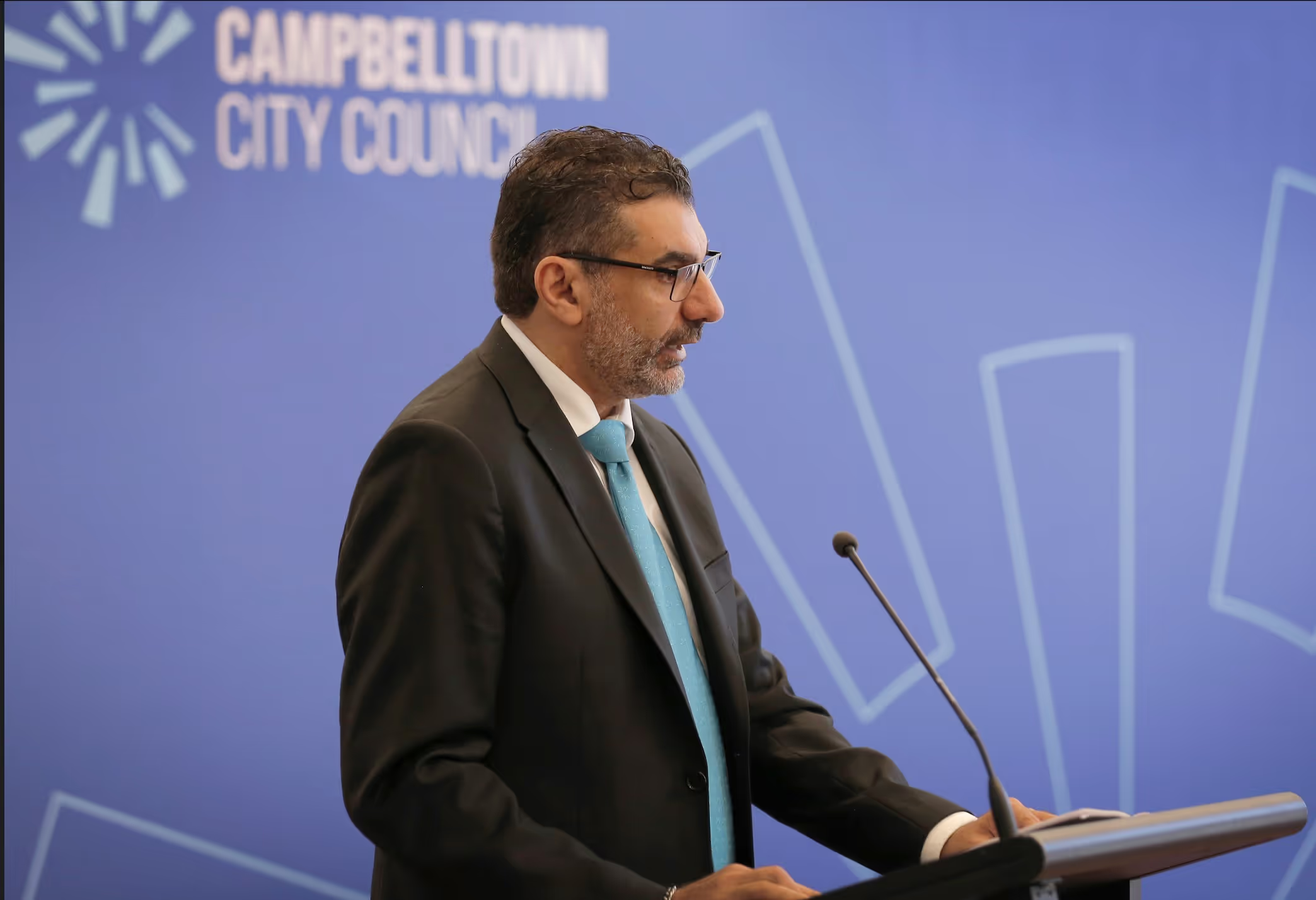
On 5 September, I was honoured to be re elected by my fellow Councillors as Mayor of Campbelltown. The increase in support from 8 to 7 in 2022 to 10 to 5 this year is, to me, a testament to the vitality of local democracy and the strength of respectful debate within our chamber.
Across 74 years of our Council’s history, 27 individuals have served as Mayor. I now continue that lineage as the 28th. Tenures have ranged from a single year to eight unbroken years. Each has reflected the context of its time. I have valued this journey deeply and, through it, have gained a fuller appreciation of our community’s aspirations and of the intricate machinery that underpins government.
We are operating in an environment where expectations increase while resources remain constrained. Yet our commitment to the residents of Campbelltown remains constant. We will continue to deliver the best outcomes we can within the resources available and within our legislative responsibilities.
“Local Government can function as an efficient service provider while maintaining local political representation and fostering collaboration with communities to shape the local physical and social landscape.”
The Dual Nature of Local Government
Local Government in Australia has long operated within a framework shaped by vertical fiscal imbalance. We rely heavily on grants from State and Federal governments to perform essential functions. Less visible, but equally significant, is what I would describe as a vertical democratic imbalance. Councils often require approval from higher levels of government to undertake certain actions, even where those actions relate directly to local priorities.
Traditionally, two models have defined local government. The first sees councils primarily as service providers. In this view, efficiency and economic management dominate. State oversight is strengthened to ensure fiscal discipline and uniform standards.
The second model recognises local government as a form of democratic self governance. Here, emphasis is placed on representation, accountability and accessibility. Councils are seen as legitimate forums for local choice and diversity.
There is also a third concept frequently discussed, known as place shaping. While debated in academic circles, I align with those who consider it integral to the New South Wales system, particularly in the realm of urban planning. Councils are uniquely positioned to shape the physical and social character of their communities.
These roles are not mutually exclusive. The enduring tension between efficiency and democracy has shaped reforms for decades. In my view, the challenge is not to choose one over the other, but to ensure they coexist in balance.
WestInvest and Institutional Integrity
The WestInvest program illustrates both the opportunity and complexity of intergovernmental relations. Announced as a 5 billion dollar initiative to enhance communities in Western and South West Sydney, it initially indicated that Campbelltown would benefit from approximately 410 million dollars in commitments.
Of that, 171 million dollars relates to Council delivered projects including the expansion of the Campbelltown Arts Centre, park enhancements, connectivity improvements and new recreation facilities. We have received written confirmation from the Program Office and from the Premier that funding under the Local Government Allocation Round and Community Competitive Round will continue.
Additional allocations for the Australian Botanic Garden and Health Hubs at Glenfield and Liverpool remain under review, with further clarity expected in the State Budget.
What concerns me most is the evolving nature of the funding deeds for the 171 million dollars allocated to Council projects. The deeds remain unsigned and have been subject to substantial amendments. Such changes introduce risk and uncertainty into our delivery program. Councils across the region are engaging collectively, seeking advice and clarity.
It is important that funding arrangements provide certainty, transparency and fairness. I appreciate the ongoing support of Mr Greg Warren MP and look forward to constructive dialogue that secures the best outcome for our community.
Listening to Community
Amid these broader policy questions, our core responsibility remains engagement with residents. On 29 September, I hosted the first in a series of community forums at the Campbelltown Civic Hall. Approximately 50 residents attended. We discussed planning, transport, open space, employment, sporting facilities, opportunities for seniors and active transport.
The value of such forums lies not only in the information shared, but in the conversations that follow. The opportunity to speak one on one with residents reinforces the principle that local government must remain accessible. Our Customer Service team was present to assist with requests and ensure concerns were recorded and addressed.
Further forums in Campbelltown and Ingleburn will continue this dialogue. In a complex policy environment, direct engagement grounds our decisions in lived experience.
Reflection
Serving in local government requires patience, resilience and a firm commitment to democratic principle. The pressures of fiscal constraint and institutional reform are real. Yet the legitimacy of our system rests on the capacity of local representatives to shape place in partnership with their communities. As we navigate funding uncertainties and broader reforms, I remain guided by the belief that efficiency and democracy must coexist. In that balance lies the enduring strength of Campbelltown.
Read the original Mayoral Minute here: 17. Serving in Local Government