


When I stepped back from Council, I did so with clarity and optimism — not just about where our cities were headed, but about the role planning could play in shaping our future. For over two decades, I’ve worked at the intersection of planning, politics, and community, as a mayor, consultant, and researcher. I’ve seen the power of good planning to create liveable, inclusive, future-ready places. I’ve also seen how easily it can be derailed by short-term thinking — and how costly that can be for clients, communities, and councils alike. Greiss Planning exists to bring clarity, rigour, and steady leadership to the approvals process, so good projects can move forward with confidence.

Abstract
Sydney’s housing debate is often framed as a contest between neighbourhood character and the need for additional dwellings. That framing is too narrow. The deeper issue is how the city distributes growth, opportunity and infrastructure burden across different communities. When well located areas resist additional housing while outer suburbs absorb much of the city’s population growth, the planning system can reproduce inequality even without explicit discriminatory intent. This article examines NIMBYism as a metropolitan governance problem, rather than merely a local political behaviour. It considers how housing resistance, migration, infrastructure capacity and spatial inequality interact to shape ethnic and socioeconomic patterns across Greater Sydney. The issue raises broader questions about planning fairness, civic trust and the stewardship of place.
Key Themes
- NIMBYism is not only a question of local opposition, but a metropolitan governance issue.
- Restricting housing in high opportunity areas can shift growth pressure to outer suburbs with greater infrastructure needs.
- Planning systems can produce racialised and unequal outcomes without explicit discriminatory intent.
- A fairer city requires better alignment between housing supply, infrastructure, jobs, services and democratic accountability.
Introduction: the governance problem beneath local resistance
Sydney’s housing debate often begins with a familiar tension. Established communities seek to protect neighbourhood character, amenity and local identity. Governments seek to increase housing supply, improve affordability and accommodate population growth. Developers seek certainty, feasibility and timely approvals. Future residents seek access to housing in places connected to employment, transport, services and opportunity.
These interests are not easily reconciled. Nor should local concern be dismissed as inherently illegitimate. Communities are entitled to scrutinise development proposals, question design quality, raise infrastructure concerns and participate in planning decisions that affect their everyday environment.
The difficulty arises when local resistance in well located and affluent parts of the city produces metropolitan consequences that are borne elsewhere. When areas close to jobs, transport, services and established infrastructure resist additional housing, growth pressure does not disappear. It is displaced. In Sydney, that displacement has often meant continued expansion toward outer suburbs, particularly in Western Sydney, where infrastructure, employment access, heat exposure and service provision are already significant policy concerns.
Viewed through a planning lens, NIMBYism is therefore not merely a local attitude. It is a governance condition. It shapes who gains access to opportunity, which communities absorb growth, and how the benefits and burdens of urban change are distributed.
Housing supply is also a question of location
Housing policy is often discussed in numerical terms: how many dwellings are approved, how many are completed, and how many are needed to meet projected demand. These measures are important, but incomplete. A dwelling is not only a unit of supply. It is a point of access to a wider urban system.
Where housing is located affects access to jobs, schools, universities, hospitals, public transport, open space, social infrastructure and cultural life. It also affects household transport costs, commute times, environmental outcomes and the capacity of local government to maintain public assets.
This is why the geography of housing supply matters. Recent analysis cited in the public debate found that less than 20 percent of new dwellings in Sydney between 2016 and 2021 were built within 10 kilometres of the CBD, while much residential development occurred 30 to 40 kilometres from the city centre.
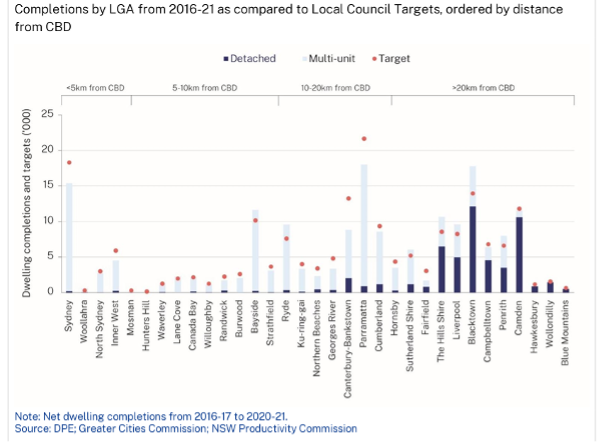
This spatial pattern has important implications. If new housing is concentrated far from employment centres and established infrastructure, the cost of growth is transferred into transport systems, household budgets, infrastructure backlogs and daily time burdens. The city may increase dwelling numbers while deepening inequality in access to opportunity.
The question is not whether Western Sydney should grow. Western Sydney is one of Australia’s most significant urban regions, with its own economic, cultural and civic identity. The question is whether the distribution of growth across Greater Sydney reflects a fair metropolitan settlement, or whether some communities are being asked to absorb a disproportionate share of change because other areas have greater capacity to resist it.
NIMBYism and the unequal politics of participation
Planning systems rely on participation. Public exhibition, submissions, local debate and elected representation are essential components of democratic planning. However, participation does not occur on equal terms across the city.
Communities with greater wealth, professional networks, political access, time and organisational capacity are often better placed to resist development. Their objections may be framed through recognised planning concepts: traffic, parking, local character, heritage, overshadowing, density, design quality, tree canopy, infrastructure capacity or environmental impact. Some of these concerns may be valid in particular cases.
The institutional problem emerges when localised objections, individually reasonable or procedurally legitimate, accumulate into exclusionary metropolitan outcomes. A suburb may resist additional housing to protect amenity. Another may do the same. Over time, high opportunity areas can remain relatively protected from change, while less affluent or more distant areas accommodate the growth that the metropolitan region still requires.
This reflects a deeper misalignment between local decision making and metropolitan responsibility. Planning decisions are often experienced locally, but their consequences are regional. A refusal, downzoning, delay or density constraint in one part of Sydney affects housing availability, affordability and urban form elsewhere.
This does not mean local communities should be removed from the planning process. It does mean that local participation must be situated within a broader civic obligation. The right to have a say about change should not become the practical power to exclude others from opportunity.
Spatial inequality and racialised outcomes
The distribution of housing growth in Sydney also has demographic consequences. Greater Sydney’s population growth is strongly shaped by international migration, and migration patterns influence the cultural and ethnic composition of different parts of the city. Publicly reported analysis has noted that most of Sydney’s population growth is expected to come from international migration, while outer areas are projected to absorb much of the city’s future population increase.
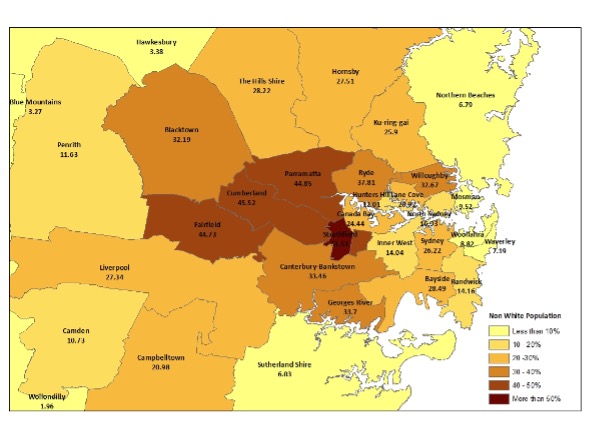
This creates an important planning question. If new housing supply is concentrated in outer suburbs, and if new migrants are more likely to rely on that supply, then the housing system can reinforce ethnic concentration across the metropolitan area. The outcome may be racialised even where individual planning decisions are not explicitly racist.
This distinction is crucial. A planning system can generate unequal outcomes through ordinary mechanisms: zoning controls, political resistance, infrastructure sequencing, development feasibility, land availability, market pricing and differential access to decision makers. No single decision needs to contain discriminatory intent for the cumulative result to be exclusionary.
The concept of systemic racism is relevant here because it focuses on outcomes embedded in institutional structures rather than only individual prejudice. The public debate around Sydney’s housing geography has drawn attention to this issue, arguing that racially unequal opportunities and outcomes can emerge with or without intention or awareness.
For planning, the implication is significant. Urban governance cannot assess fairness only by asking whether a process was formally neutral. It must also ask whether the outcomes of that process distribute opportunity, infrastructure and social burden equitably.
Western Sydney and the infrastructure burden of growth
Western Sydney’s growth is often discussed as evidence of opportunity, and in many respects it is. The region is central to Sydney’s future, with major investments in transport, employment lands, health, education, airport related development and civic infrastructure. However, growth without adequate infrastructure sequencing risks reproducing disadvantage.
Outer suburban expansion can impose costs that are not always visible in housing approval figures. These include longer commutes, car dependence, pressure on local roads, delayed public transport, limited access to jobs, heat vulnerability, flood risk, infrastructure backlog and increased demand for local services. Public reporting on Sydney’s growth debate has also noted concerns about development in areas exposed to extreme summer heat, bushfire and flood risk.
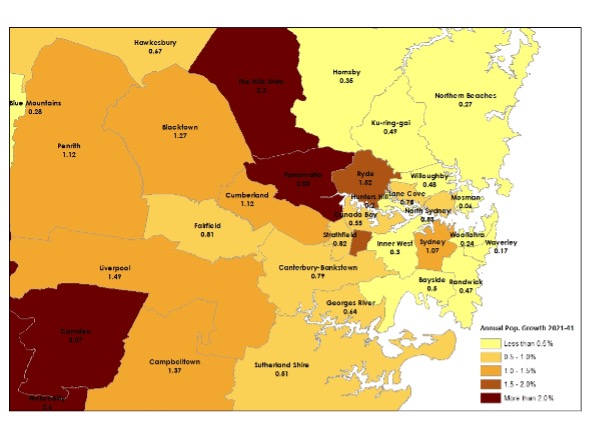
This is not a reason to oppose growth in Western Sydney. Rather, it is a reason to treat growth as a stewardship responsibility. New housing must be matched with infrastructure, employment access, public space, tree canopy, climate resilience, schools, health services, libraries, recreation facilities and transport choices.
The problem arises when outer areas become the default location for housing that better serviced areas decline to accommodate. This can produce a two speed city: one part protected by scarcity and amenity, another carrying the cumulative burden of growth.
Civic trust and the fairness of urban change
Housing reform depends on civic trust. Existing residents need confidence that growth will be accompanied by infrastructure, design quality and environmental care. Future residents need confidence that the planning system will not permanently exclude them from high opportunity areas. Local councils need confidence that housing targets, infrastructure funding and service responsibilities are aligned. State government needs confidence that metropolitan objectives can be implemented without eroding democratic legitimacy.
NIMBYism becomes especially difficult because it operates at the intersection of legitimate concern and structural exclusion. Residents may oppose development for reasons that are sincere and locally grounded. Yet the metropolitan effect may still be unfair.
A mature planning system must be able to hold both truths at once. Community concern should be heard, but not allowed to become a veto over shared urban responsibility. Housing targets should be pursued, but not through blunt density without infrastructure. Local character should matter, but not be used as a static concept that freezes high opportunity suburbs while other areas absorb change.
The stewardship of place requires a broader ethic of reciprocity. Every part of the city benefits from metropolitan growth, labour markets, infrastructure systems and public investment. Every part of the city should therefore contribute, in some proportionate way, to housing the population that sustains that shared prosperity.
Toward a fairer metropolitan settlement
A fairer approach to housing growth in Sydney would begin by treating location as central to housing justice. Increasing supply in poorly serviced locations is not equivalent to increasing supply near jobs, transport and social infrastructure. The planning system should therefore give greater weight to the relationship between housing, opportunity and infrastructure capacity.
This does not require uniform density across every suburb. It requires a more disciplined metropolitan framework that asks:
- where additional housing creates the greatest public benefit;
- where infrastructure already exists or can be efficiently upgraded;
- where exclusionary scarcity is protecting advantage;
- where growth is intensifying service deficits or climate exposure;
- and how local participation can be reconciled with citywide responsibility.
Such a framework would also require stronger integration between land use planning and infrastructure funding. Higher density in established areas must be supported by transport, schools, open space, community facilities and urban design quality. Growth in Western Sydney must be matched by jobs, services, climate adaptation and long term public investment.
The aim is not to replace one inequity with another. It is to avoid a planning system in which resistance is most effective where opportunity is already concentrated, while growth is most intense where infrastructure need is greatest.
Conclusion
NIMBYism in Sydney should not be understood only as a cultural attitude or a local political habit. It is part of a wider metropolitan governance problem concerning the distribution of housing, opportunity, infrastructure and demographic change.
When well located areas resist new housing, the consequences extend beyond their boundaries. Housing demand is redirected. Growth moves outward. Infrastructure pressure intensifies. Commutes lengthen. Environmental risks increase. Access to opportunity becomes more unequal. Over time, these patterns can reinforce socioeconomic and ethnic divisions across the city.
The central planning issue is therefore not simply whether Sydney needs more housing. It is where that housing is located, who has access to it, which communities absorb its impacts, and whether the institutional structure of planning distributes urban responsibility fairly.
A more equitable Sydney will require more than dwelling targets. It will require metropolitan stewardship: the capacity to align housing supply with infrastructure, climate resilience, migration, local democracy and social inclusion. The test of planning fairness is not only whether communities are consulted. It is whether the city that results from those decisions remains open, connected and just.
This article draws on work originally published in The Conversation with Professor Awais Piracha under the title: NIMBYism in Sydney is leading to racist outcomes.
References
Piracha, A., & Greiss, G. (2023). NIMBYism in Sydney is leading to racist outcomes. The Conversation, 18 July 2023. Republished by Western Sydney University.
Australian Financial Review. The suburbs that are home to Sydney’s biggest NIMBYs. https://www.afr.com/politics/federal/the-suburbs-that-are-home-to-sydney-s-biggest-nimbys-20230308-p5cqam
Commonwealth of Australia. 2022 Population Statement. https://population.gov.au/publications/statements/2022-population-statement
Department of Home Affairs. 2021–22 Migration Program Report. https://www.homeaffairs.gov.au/research-and-stats/files/report-migration-program-2021-22.pdf
The Guardian. Essential workers priced out of housing near Sydney. https://www.theguardian.com/australia-news/2023/jun/08/essential-workers-priced-out-of-housing-near-sydney
News.com.au. NSW Premier Chris Minns puts Sydney NIMBYs on notice. https://www.news.com.au/finance/real-estate/sydney-nsw/nsw-premier-chris-minns-puts-sydney-nimbys-on-notice/news-story/aef04c273a0b04c81531bd5cf989eaae
NSW Productivity Commission. Building more homes where people want to live. https://www.productivity.nsw.gov.au/sites/default/files/2023-06/202305_01-building-more-homes-where-people-want-to-live.pdf
Sydney Morning Herald. From Bondi to Byron: wealthy suburbs with shrinking populations. https://www.smh.com.au/politics/nsw/from-bondi-to-byron-wealthy-suburbs-with-shrinking-populations-20221125-p5c1a2.html
Sydney Morning Herald. Leichhardt’s rundown Italian Forum sold to mystery developer. https://www.smh.com.au/national/nsw/leichhardt-s-rundown-italian-forum-sold-to-mystery-developer-20230404-p5cy09.html
Uddin, K. F. and Piracha, A. 2023. Urban planning as a game of power: The case of New South Wales (NSW), Australia. Habitat International, 133, 102751.
https://doi.org/10.1186/s41235-021-00349-3