Subscribe to get news update

Service areas / Bayside
Planning advice and development applications across the Bayside local government area — Rockdale, Arncliffe, Banksia, Bexley, Brighton-Le-Sands, Mascot, Botany, Eastgardens and the Botany Bay foreshore. Four station precincts, an international airport and some of the most contaminated ground in Sydney make this a local government area where the pathway question is rarely simple.
Talk about your Bayside siteLast updated: 4 August 2026 · Written by Dr George Greiss
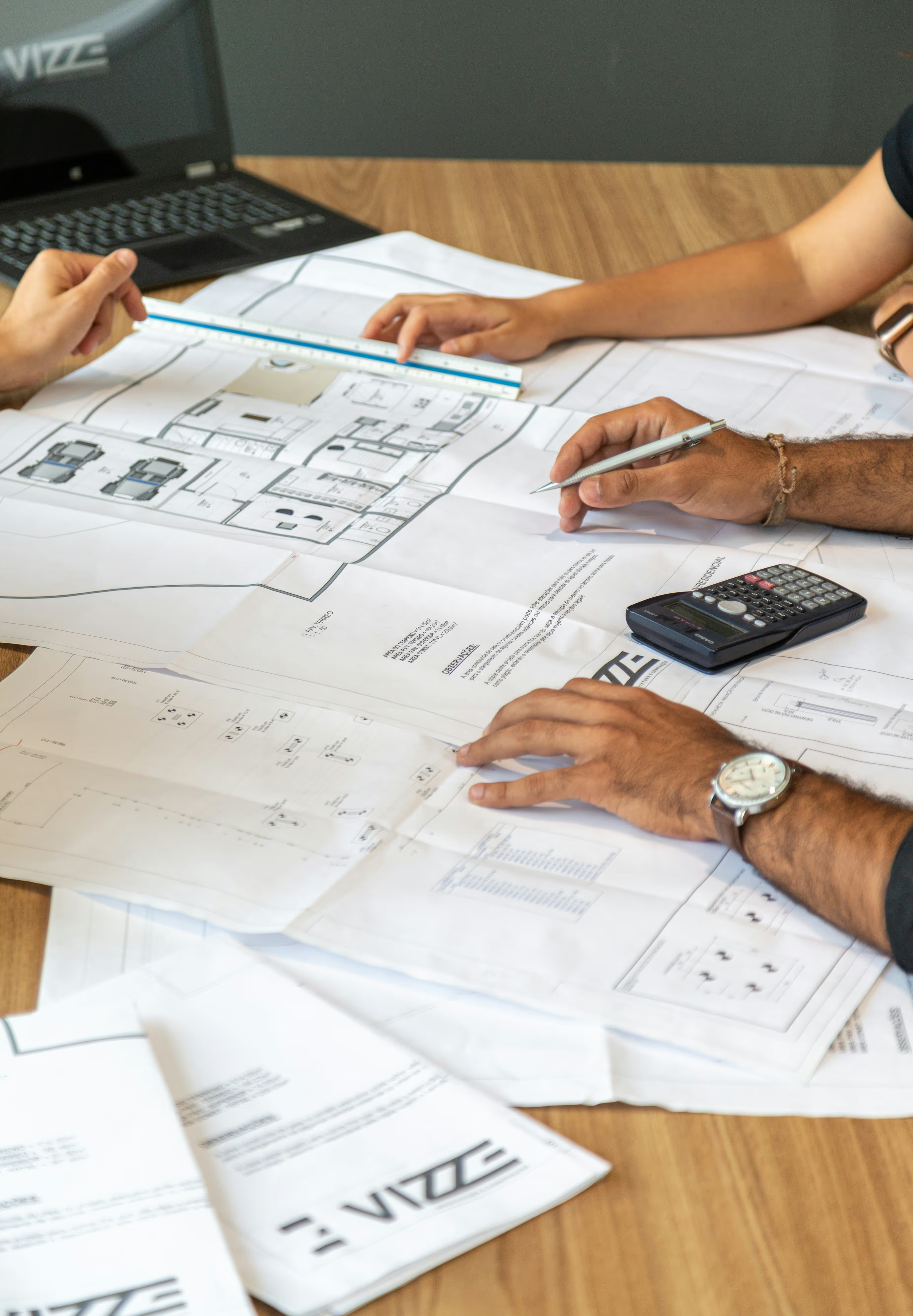
We act for landowners, builders and small developers on sites across the Bayside local government area. The work has run from dual occupancy and multi dwelling proposals in the established residential suburbs, through torrens and strata subdivision, industrial and warehouse development and change of use applications, to section 4.55 modifications and building information certificates for work already carried out.
Client names, addresses and application numbers stay confidential — we describe the type of matter, never the site. The person who reviews your site is the person who writes the report and deals with Council.
Bayside Local Environmental Plan 2021 is the principal instrument, and it is worth knowing that it is genuinely one instrument. When Rockdale and Botany Bay merged in 2016 they inherited three planning instruments between them; all three were repealed on 27 August 2021 when the consolidated LEP commenced. There are no deferred matters. Zones are fully translated to the reformed suite — R2, R3 and R4 for residential, E1 through E4 for the centres and employment land, MU1 for mixed use, and SP4 Enterprise, which is unusual and now covers most of the Cooks Cove land.
Two areas sit outside the LEP altogether. Cooks Cove is governed by the Eastern Harbour City Precincts SEPP, and Port Botany and its surrounding land by Chapter 5 of the Transport and Infrastructure SEPP — which prevails over the LEP, still uses the old IN1, IN2 and IN3 industrial zones, and makes the Minister rather than Council the consent authority for land in the lease area, unzoned land and the Intertrade Industrial Park. On that land your application may not be a Council application at all.
Bayside Development Control Plan 2022 came into force on 10 April 2023 and replaced the two inherited DCPs — but those older plans still apply to applications lodged before that date. That is a lodgement-date rule, not a geography rule, and it still catches people out on long-running matters.
The overlap between the two policies is the single most misunderstood thing about them. We have set it out in full, with three other common errors, here: Low and Mid-Rise Housing in NSW — four things people keep getting wrong.
Bayside runs two tiers of pre-lodgement advice. The Development Advisory Service is free and by appointment at the Rockdale and Eastgardens customer service centres, and is the right first call for pathway and permissibility questions. Formal advice comes through a paid pre-lodgement meeting, priced on a cost-of-works ladder that runs from $904 for work up to $500,000 to $5,315 above $20 million.
Budget for the Design Review Panel. All new commercial, industrial, multi-unit housing and residential flat buildings must be presented to it, at the applicant's expense — currently around $4,300 under $50 million and $6,300 above it, with further fees for repeat referrals and for the separate design excellence process that LEP clause 6.10 imposes on some sites. It is a real cost and a real timing item, and it is the one most applicants have not allowed for.
The Bayside Local Planning Panel meets at 5pm on the second and fourth Tuesday of each month and determines roughly 95 of the 600 or so applications lodged each year. Ten or more unique objections will send an application to the panel, as will a contravention of a development standard by more than ten per cent or of any non-numerical standard. Requests to speak close at 5pm on the preceding Friday and you get three minutes.
On the Department's most recent Faster Assessments figures, Bayside averaged 102 assessment days in 2025-26, measured gross with no stop-the-clock. That sits mid-field for the area — Randwick 69, Canterbury-Bankstown 80, Sutherland 97, Georges River 147 — against a benchmark that tightened to 90 days from 1 July 2026.

It cannot be both. Turrella, Banksia, Rockdale and Kogarah carry Transport Oriented Development controls, and the Housing SEPP excludes that land from the low and mid-rise chapter entirely. The low and mid-rise inner-area standards apply cleanly only around Arncliffe, Bexley North and Rockdale Plaza. Both are mapped, so it needs an address-level check.
LEP clause 6.8 applies from ANEF 20 and requires the consent authority to consider the siting table in AS 2021 and be satisfied of its indoor sound levels. Above ANEF 25 the Standard does not recommend housing, but the Court has confirmed it is a guide rather than a prohibition. The low and mid-rise exclusion, separately, bites at ANEF 25.
If the proposal is a controlled activity under the Airports Act — commonly a building or crane intruding into prescribed airspace, but also glare, smoke, dust or turbulence — then yes, and LEP clause 6.7 requires that approval to be obtained before consent is granted. It cannot be conditioned, and there is no NSW referral process. On tall buildings this drives the program.
Frequently. All five acid sulfate soil classes are mapped across the local government area, and in Class 2 land any works below natural ground surface trigger the clause. Contamination is the local signature after a century of industry, so a section 10.7 certificate is the first step — Council keeps a contaminated sites register but does not publish it.
All new commercial, industrial, multi-unit housing and residential flat buildings must be presented to Bayside's Design Review Panel, at the applicant's expense — currently around $4,300 under $50 million and $6,300 above. Some sites also trigger a separate design excellence process under LEP clause 6.10. Both are cost and program items worth allowing for at feasibility.
Send through the address and what you have in mind. You will get a straight answer on the pathway, the constraints that matter and what it would take — and a fixed-fee quote if we go ahead.
Get in touch